
We were recently fired from a site by a large-scale national property management group for snow and ice services for a commercial property in the Nampa, Caldwell Market. Why do you ask? Well, it comes down to understanding expectations…
Expectations
Snow and ice management expectations are difficult to manage. Even when you have written contracts with clearly defined terms, there are still nuances and blurred lines when it comes to certain clients. Some commercial properties have large budgets for Snow and Ice Management. Other local small businesses may pay for this service out of necessity, and the costs come straight off the bottom line for them, so every storm event that comes is a strain financially. Even if these two examples have the exact same 2” trigger, the sentiment we receive from each client is starkly different. The commercial management group is wondering why we haven’t arrived yet at 1.5” threshold because their tenant has complained about the build up of snow on the sidewalks, where the small business owner might have already cleared the walks, spread some salt, and would rather we come after the storm finishes so they only pay for one service on that storm. While we try to factor in these concerns, with a fleet of 20-30 crews in the field, often we must perform the service in the most efficient way possible, potentially upsetting both of these clients depending on the timing of the storm.
The Terrible “T’s”: Triggers, Tolerances, and Timing.
There is some industry Jargon that the Snow and Ice industry has adopted over the years to help with client expectations. These terms can be confusing and also don’t necessarily define intent. The first and probably most important is the concept of “Triggers”. A trigger is the allowable snow threshold a client chooses to initiate a service. See below standard language from an agreement from the client who terminated our service.
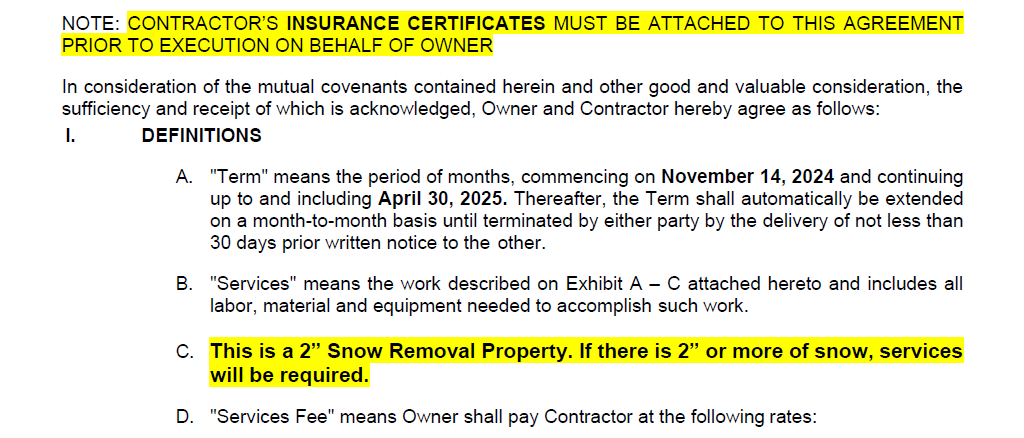
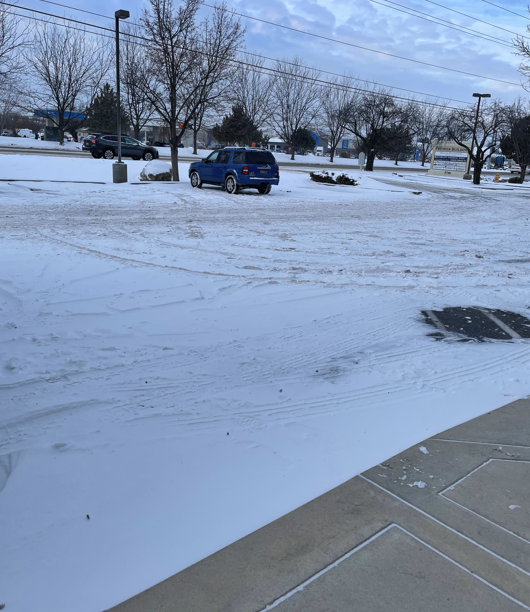
So, as we can see in section C above, the “Trigger” for service for this account is an accumulation of “2 inches or more of snow”. This is common industry language. Well, what is not clear from this language is what happens if we get ½” of sleet, it freezes solid, and stays below freezing for several days. Or in the case with the situation above, the scenario was a combination of hard pack from traffic throughout the day and wind swept from the storm. Our technician visited this site two times, once during the event and once after trying to perform work. We have GPS records that prove his visit to the site. The problem wasn’t a lack of effort, it was a judgment call where our technician felt the site did not meet the trigger threshold. As you can see from the photo below (Sent the morning of termination), the majority of this parking lot does not have 2” of snow accumulation.
When our account manager visited the site after hearing the complaint, this is what was measured onsite.
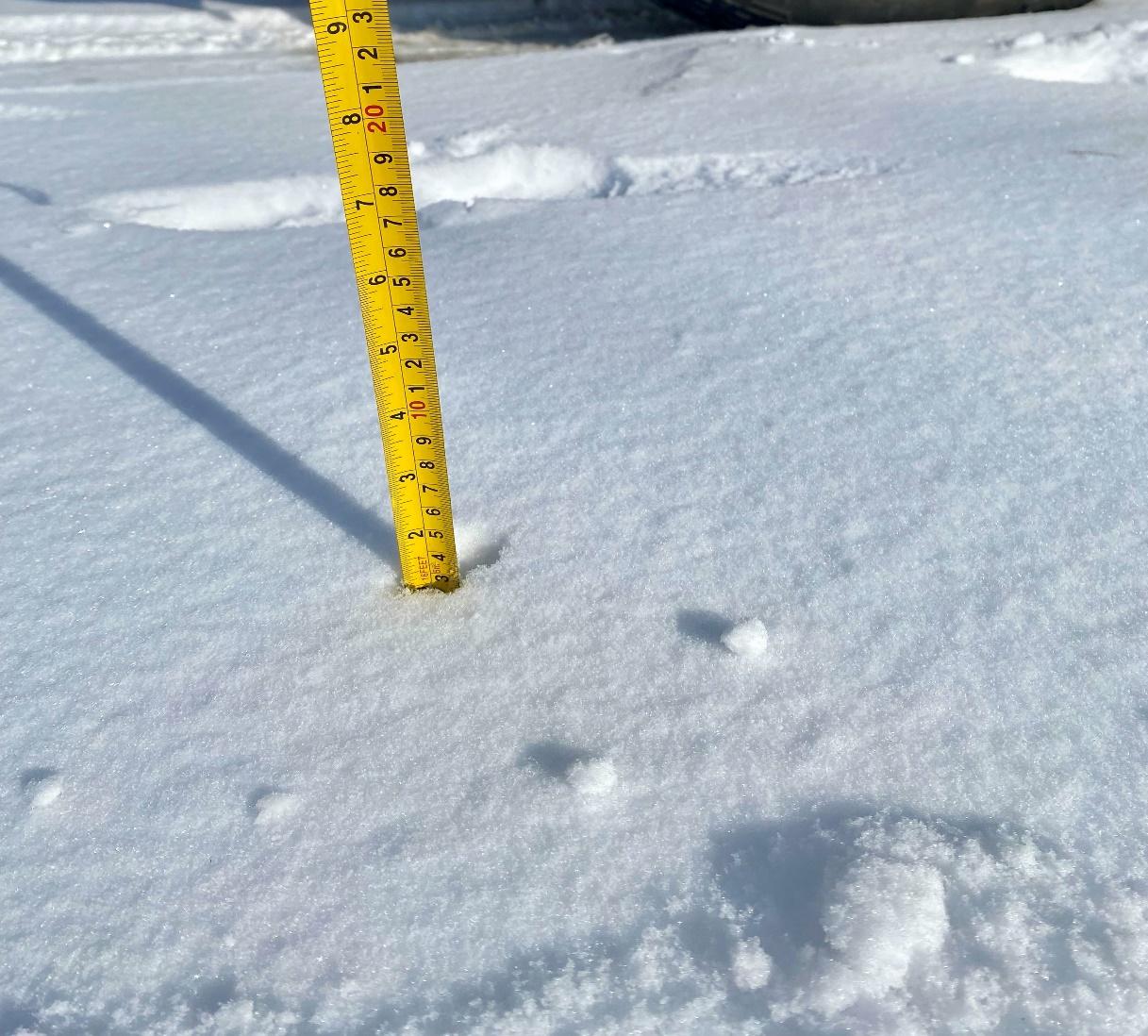
Certainly, there were some areas in and around the edges and north face that had drifted snow over two inches, and valley wide, the storm accumulated around 2”, so I understand the frustration from the Commercial Property Management company, and this property should have been serviced. And why wouldn’t we? We were already onsite for an inspection and had plenty of time to perform the work. In this case, we run the risk of not getting paid because we don’t meet the trigger. This is the grey area, with the client's expectation that I was discussing above. In this situation, while trying to respect the terms of the written contract, our technician made the wrong call. We will use this situation as a means of training. When we train our teams, we always preach “Error on the side of Caution” when it comes to performing services. For example, if a snow plow trigger is 2” and when we arrive, it is 1.5” in accumulation and still snowing, we will likely perform the service. Our philosophy is we would rather fight over a $300 bill and why we overperformed, than for our client to have a slip and fall accident and end up in a legal battle that may cost $30K and may likely involve us too.
It is our professional opinion that there should also be a separate trigger for Deicing services, because in the Treasure Valley market, ice events occur more often than Snow events. Setting these expectations with clients up front also helps eliminate grey areas in the verbiage.
Tolerances
Insurance companies, Lawyers, and Gold Diggers love to debate over tolerance for snow and ice management. “Zero Tolerance” Contract language is all the rage, and as snow contractors, we love the concept of Zero Tolerance for two reasons. 1. It will likely provide a much steadier stream of work and revenue in an otherwise slower time of year. 2. It sets the clearest expectation for timing (which I will discuss shortly). The problem is it leaves a relatively ambiguous set of expectations for literally everyone else. Since most clients won’t pay for zero-tolerance work, how do the rest of the clients get plugged into the route after we define the highest priority? We typically fall back on Triggers to set our standard. See example below:
|
Priority #1 |
Zero Tolerance |
Medical, Government, Schools |
|
Priority #2 |
1 Inch Trigger for Snow |
Retail, Shipping Facilities |
|
Priority #3 |
2 Inch Trigger |
Commercial, Industrial |
|
Priority #4 |
3 Inch Plus, and on call clients |
Residential, HOA’s |
This also makes sense from a timing standpoint, obviously it will take longer for a site to reach 2” giving more time to complete the higher priorities. I understand that commercial property managers don’t really care about our workload and how our company handles it. They just want to know that the moment it hits 2” of snow on their property, we are there making everything safe and wonderful. Well, this is never how it works in the real world specifically because Mother Nature is a Bitch when it comes to her timing….
Timing
My perfect snow event would be for snow to start falling mid-afternoon and reach accumulations of 2” or more at about 11:30 pm and stop. Typically, we allocate about 6-8 hours of work for each crew on their route, prioritizing the order based on each client’s trigger. That means if we start service around midnight, we are complete with our work prior to the 7 am window when many people begin arriving for work. Yea! Everyone is happy, but this almost never happens! The worst event is one that begins snowing at 3-4 am, hard and hits its 2” threshold about 7:30 am. Well, it's 5-6 am when our crews hit the ground, and we have 6-8 hours of work to do in the next hour and a half. Nearly every single commercial snow agreement I have ever seen says something like….
“All work must be complete by 8 a.m.”
While I understand the sentiment when I see this clause, I always joke about the guy who wrote it. Certainly a lawyer, and definitely never been involved in the production of snow services, as this is virtually impossible to guarantee. There have been instances during a storm when it was snowing so hard that I couldn’t guarantee that I would clear the lot by the time I finished the end of the lot. If the trigger threshold is met at exactly at 7:59 a.m., am I still required to have it clear by 8 a.m.? I would like to ask the lawyer who wrote this specification that question. A clearer specification might be “contractor will endeavor to have service complete by the beginning of business operations or have equipment onsite within 2 hrs. of reaching the trigger threshold”. The problem is that this language doesn’t win settlements in the trial.
Conclusion
There is never an easy way to manage expectations, and of course, due to the litigious nature of the industry, no contract will ever have a grey area in it. Every lawyer will argue that “8 a.m. means 8 a.m. by God.….. breach of contract!”. In most cases, if we do our work well, and people come and go to their places of business without incident, then life is good, and everyone is happy. All this to say that understanding the nuances of what a client wants, what the Commercial Property Manager wants, and what may be on paper will take open lines of communication and a ton of luck.